Meaningful activities in later life do not need to be elaborate. Sometimes, something as simple as brushing and plaiting another person’s hair can create a moment of purpose, connection and genuine happiness.
One of our customers recently reminded us of exactly that.
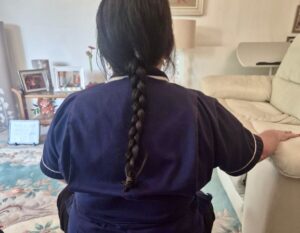
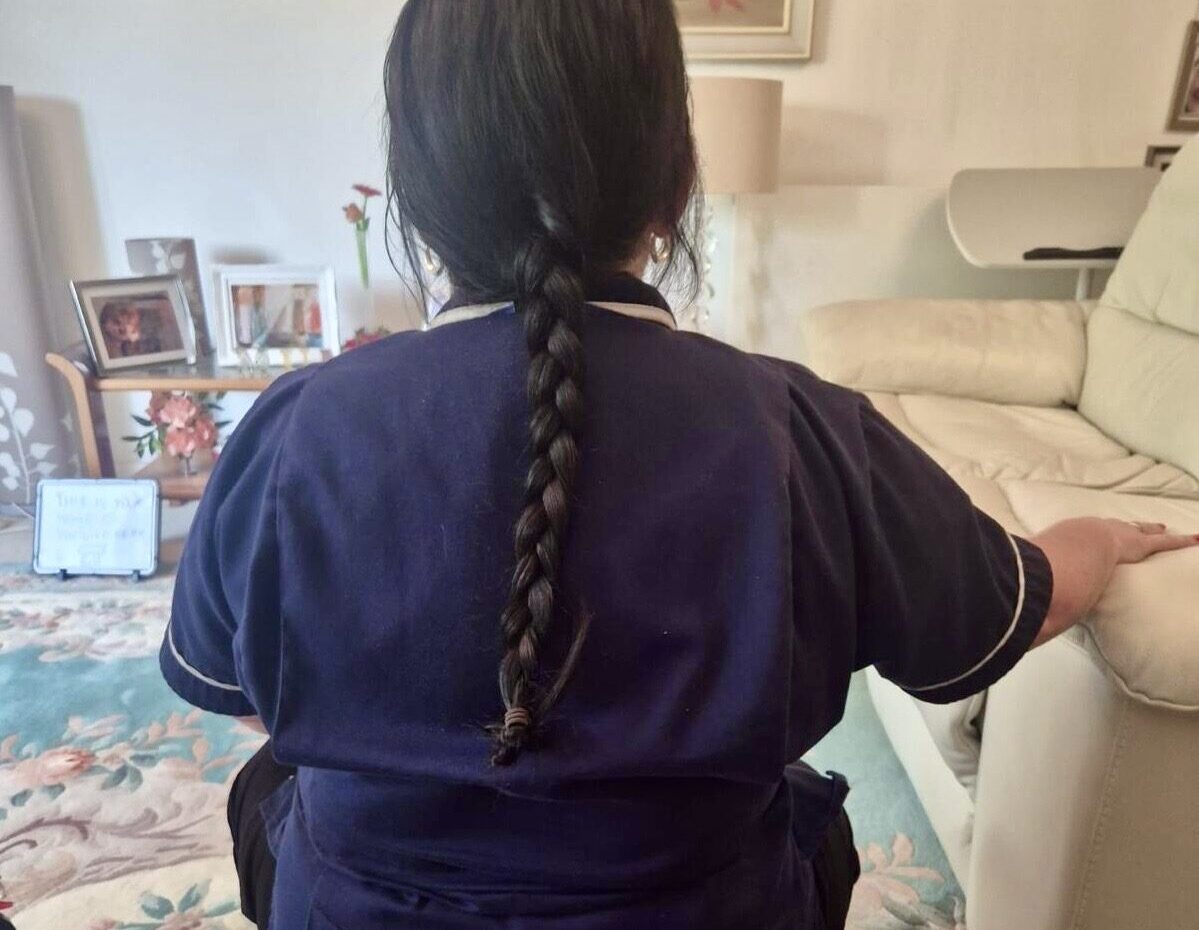
During a visit from her Braeburn Care Professional, Kelly, our customer mentioned something she would really like to do the next time they saw each other: brush and plait Kelly’s long hair.
It was a simple request. But Kelly listened.
A request worth remembering
When Kelly returned for her next visit, she arrived with something extra alongside everything needed for the usual care visit: a hairbrush and hair bands.
After completing her customer’s care, Kelly asked whether she could remember what she had requested during their previous visit.
She remembered immediately.
When Kelly produced the brush and hair bands she had brought especially for her, our customer was delighted.
She then spent time brushing Kelly’s long hair before plaiting it herself – something she had been looking forward to doing.
It was a lovely moment. But there is an important point behind it.
Our customer wasn’t simply having something done for her. She was the one doing something she enjoyed.
Care shouldn’t always be about what we can do for someone
When somebody begins receiving care, the focus can understandably shift towards what they need help with.
What needs preparing? What needs prompting? What can they no longer manage independently?
Those questions matter enormously. But they should not become the only questions we ask.
There is another one that can be just as important: What can this person still do, enjoy, contribute or share with somebody else?
That distinction matters when considering meaningful activities in later life.
Meaningful activity is not simply about keeping somebody occupied. It can provide opportunities to use existing skills, make choices, connect with others and retain the interests and routines that form part of who they are.
For our customer, brushing and plaiting Kelly’s hair provided exactly that opportunity.
Why meaningful activities matter as we get older
Our interests, skills and desire to feel useful do not disappear as we age.
Age UK research has identified participation in enjoyable and meaningful activities as an important factor in wellbeing in later life.
But what counts as meaningful will be different for every person.
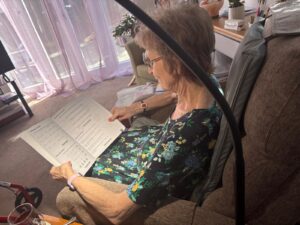
It could be gardening, baking, folding laundry, looking through old photographs, playing cards, choosing music, helping to prepare a meal or sharing a skill with somebody else.
For one of our customers, it was doing Kelly’s hair.
What matters is not how impressive or complicated an activity appears from the outside. What matters is whether it has meaning to that individual.
For our customer, there was something else that made the experience particularly special: Kelly had remembered.
Something she had said during an earlier conversation had been heard and acted upon. That created an opportunity for enjoyment and connection, but it also allowed our customer to take the lead.
Knowing the person behind the care
This is where relationships in home care become particularly important.
Over time, Care Professionals can learn the details that make each customer an individual: what makes them laugh, what they used to enjoy, what they look forward to and what gives them a sense of purpose.
The Care Quality Commission’s guidance on person-centred care emphasises the importance of understanding people’s preferences, interests, aspirations and personal histories, while supporting choice and control.
For us, this does not mean trying to manufacture an “activity” for every care visit.
It means listening and noticing.
Kelly could easily have forgotten a passing conversation about her hair. Instead, she remembered it and arrived prepared. The hairbrush and hair bands were small things to bring.
The message behind them was much bigger: I listened to you. I remembered. What you said mattered.
Looking differently at meaningful activities in later life
When families think about helping an older relative remain active and engaged, it can be easy to picture organised hobbies, groups or days out.
Those things can be valuable. But meaningful activities in later life can also be found in very ordinary moments at home.
A useful starting point can be to ask: What has this person always enjoyed? What are they good at? What makes them feel useful? What do they still enjoy sharing with other people?
The answers may lead to something surprisingly simple.
For one of our customers, it was the opportunity to brush and plait her Care Professional’s hair. For somebody else, it will be something entirely different. And that is precisely the point.
At Braeburn Care, we want the people we support to remain active participants in their own lives – with opportunities not only to receive care, but to choose, contribute, connect and continue doing things that have meaning to them.
Could someone you love benefit from more meaningful support at home?
If an older relative would benefit from companionship, greater social interaction or support to continue enjoying the interests and routines that matter to them, our team can help.
Ranked as 10/10 on homecare.co.uk, Braeburn Care provides flexible home care and companionship across Tunbridge Wells, Tonbridge, Sevenoaks, Crowborough and surrounding areas, with support shaped around each individual customer.
Call us on 01892 577680 or email enquiries@braeburncare.co.uk for an informal conversation about how we could support you or someone you love to continue living well at home.
Frequently Asked Questions
- What are meaningful activities for older people? Meaningful activities are things that have personal relevance or enjoyment for an individual. They might include hobbies, everyday tasks, conversation, creative activities, outings or opportunities to share existing skills and interests.
- Why are meaningful activities important in later life? Meaningful activities in later life can support wellbeing, social connection, identity and a sense of purpose. They can also give older people opportunities to make choices and remain actively involved in everyday life.
- What is person-centred home care? Person-centred home care looks beyond practical care tasks and considers the individual as a whole – including their preferences, routines, relationships, interests, history and what matters to them.
- Does Braeburn Care offer companionship care in Tunbridge Wells? Yes. Braeburn Care provides companionship and home care in Tunbridge Wells, with visits tailored around each customer’s individual needs, preferences and circumstances.
- Can companionship care help an older person stay socially engaged? Yes. Depending on the individual, companionship care can include conversation, shared interests, hobbies, trips into the community or simply having dedicated time with someone they know and trust.
- Does Braeburn Care provide home care in Tonbridge, Sevenoaks and Crowborough? Yes. Braeburn Care supports customers across Tunbridge Wells, Tonbridge, Sevenoaks, Crowborough and surrounding communities. Contact our team to discuss whether we cover your particular location.
- How do I arrange companionship or home care for an older relative? A good first step is to understand what your relative would like support with and what is important to them. You can then speak to Braeburn Care about their circumstances and the type of care or companionship that could be appropriate.